
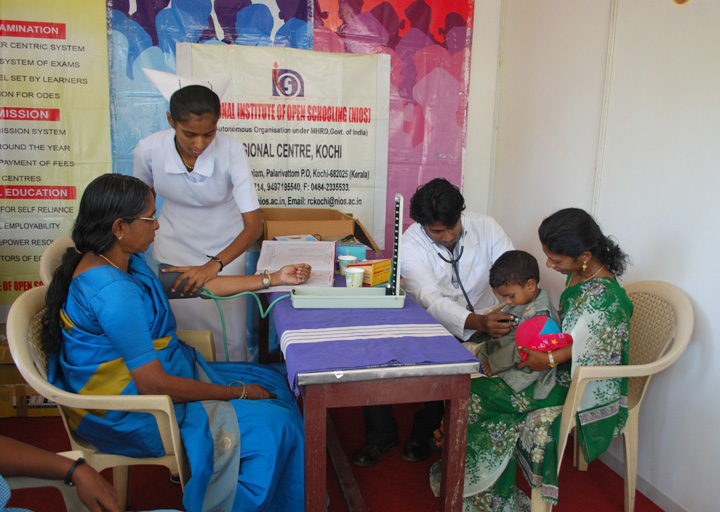
Instead of a thrust on key areas such as women and children’s health, the government has chosen to expand tertiary healthcare. India’s Budget 2026–27 was presented on February 1 with much celebration and described as a transformative step toward inclusive growth. Finance Minister Nirmala Sitharaman reiterated the government’s commitment to ensuring access to resources and opportunities for every family and community. Health sector allocations were highlighted as a sign of social development. Yet, a closer reading reveals a troubling gap: primary healthcare—the foundation of any public health system—remains neglected. The…
India Daily Post

U.S. and global oil and gas prices surged higher Monday as concerns grew that attacks by Israel and the U.S. on Iran could spiral into a broader war and disrupt global energy supplies. The U.S. and Israel launched strikes on Iran on Saturday that killed Supreme Leader Ayatollah Ali Khamenei and dozens of other senior government officials while talks between Washington and Tehran over the Islamic Republic’s nuclear program were reported to be ongoing. European benchmark Brent crude oil surged by as much as 13% in early trade on Monday,…

New Mexico Begins Investigating Allegations of Abuse at Epstein’s Zorro Ranch Property. As victims of Jeffrey Epstein’s multinational sex trafficking operation continue to push for justice, New Mexico authorities look into allegations of buried bodies at Epstein’s Zorro ranch, about 30 miles from Santa Fe. In other news, a study finds that the right cognitive training can reduce dementia risk over two decades, and California’s mental health diversion is applied to a perjury case involving a retired California Highway Patrol officer. Last week, New Mexico lawmakers approved an investigation into…

The European Union is urging a “diplomatic solution” on Iran as top EU diplomats are set to meet with the director of US President Donald Trump’s newly-created Board of Peace, and Trump continues to threaten strikes on Iran. “We don’t need another war in this region. We already have a lot,” EU foreign policy chief Kaja Kallas said Monday. “It is true that Iran is at its weakest point that they have been. We should be really using this time to find a diplomatic solution.” Working with the Board of…

Wielding a golden gavel and a playlist featuring the Beach Boys, Donald Trump ushered in a new era of international humiliation at the inaugural meeting of the U.S.-led Board of Peace. The new body, while established by Trump, has been tasked by a UN Security Council resolution to administer Gaza’s reconstruction efforts. But Trump has also suggested his ambitions for the board go far beyond Gaza, saying it would “almost be looking over the United Nations and making sure it runs properly.” Trump has demanded that world leaders pony up…

Japanese companies will finance investments valued at $36 billion in energy and minerals projects in Ohio, Texas and Georgia as part of a trade agreement that will cut U.S. tariffs on Japanese imports to 15%, according to the Trump administration. The announcement is part of Japan’s 2025 agreement to invest $550 billion over the next four years at the direction of the U.S., with the funds aimed at rebuilding and expanding core American industries. In October, the Trump administration provided details on Japanese investments of up to $332 billion to…

Japanese Prime Minister Sanae Takaichi and her ruling Liberal Democratic Party (LDP) got a historic landslide victory in last week’s parliamentary elections. This marks the first time since its founding in 1955 that the conservative LDP controls a two-thirds supermajority in the lower house. If necessary, Takaichi’s cabinet could also overrule any opposition in the upper house of the Diet (Japan’s parliament), where her coalition still lacks a majority. Given this, Takaichi now has a massive mandate to push her agenda. This includes boosting defence spending, strengthening the military and…

Dear reader, as you read this, the curtain is rising on the most significant and heartwarming moment of the year for countless Chinese families. Wanderers have returned to their nests, and lights are glowing in millions of homes. The opening act of this grand festival is, and always will be, the Nianyefan – the Chinese New Year’s Eve reunion dinner. It is more than just a carnival for the taste buds; it is a totem of emotion and belonging. However, if we zoom out and look at the rising steam…

Valentine’s Day: The Politics and Psychology of Hating Love. Each year Hindu nationalist groups carry out violent crackdowns on couples in public spaces during Valentine’s Day in India. These incidents show how moral policing, group identity politics and anxiety about social change combine to justify control over private emotion and public behaviour. On Feb. 14, activists linked to Hindu nationalist organisations entered NMIMS University in Indore and allegedly vandalised property after claiming that an obscene Valentine’s Day related program was being organized on campus, according to The Telegraph. The university…

Japan is preparing to lift long-standing restrictions on lethal weapons exports, marking another step in the erosion of its post-war arms export taboo. While the reform creates new diplomatic and commercial opportunities and allows deeper security cooperation with regional partners, Japan’s defence industrial base remains small, costly and capacity-constrained. Domestic procurement demands and labour shortages mean exports will likely remain modest, limiting the policy’s practical and strategic impact on regional military balances. Prime Minister Sanae Takaichi’s government is looking to loosen Japan’s long-standing restrictions on weapons exports, marking another step…